MEETING HIGHLIGHT
Redefining CKD management: Early comprehensive cardiorenal protection with empagliflozin across the CKM continuum


Chronic kidney disease (CKD) remains a major global health challenge contributing substantially to cardiovascular (CV) morbidity, mortality, and healthcare utilization.1,2 Increasing evidence suggests that CKD should be viewed as an integral component of the cardio-kidney-metabolic (CKM) continuum, in which dysfunctions of the heart, kidneys, and metabolic systems are closely interconnected and mutually reinforcing.3,4 At the Hong Kong Medical Forum 2026, Professor Takashi Yokoo highlighted the evolving understanding of CKD within the CKM continuum and outlined the evidence supporting the early use of sodium-glucose cotransporter 2 (SGLT2) inhibitors, particularly empagliflozin, for comprehensive cardiorenal protection across diverse CKD populations.5,6
CKD within the CKM continuum
In both Japan and Hong Kong, the number of patients requiring dialysis has increased substantially over the past three decades, accompanied by rising healthcare expenditure.7,8 Beyond progressive kidney failure, CKD frequently coexists with hypertension, type 2 diabetes (T2D), heart failure (HF), and atherosclerotic cardiovascular disease (ASCVD).3,4 These conditions are increasingly recognized as part of an interconnected CKM spectrum.3,4 Importantly, the presence of one CKM condition substantially increases the risk of developing additional disorders within the spectrum, reflecting bidirectional interactions among these disease domains.3,4 This clustering of interrelated conditions results in premature mortality and considerable healthcare utilization, contributing to global healthcare expenditure estimated at nearly US$2 trillion annually.3
More than one-third of adults in the United States have multiple CKM risk factors.9 The coexistence of T2D and CKD is associated with a 3-fold higher risk of CV mortality compared with T2D alone.10 Shared hemodynamic, neurohormonal, and inflammatory mechanisms create a self-perpetuating cycle whereby metabolic dysfunction promotes kidney injury, declining kidney function accelerates CV complications, and HF further exacerbates renal impairment.4 Prof. Yokoo emphasized, “We need to slow CKD progression and delay the need for dialysis as much as possible, not only to improve outcomes for our patients, but also to reduce the burden on society. To achieve this, we need to rethink how we manage CKD and adopt a more holistic approach to patient care.” These interrelationships highlight the opportunity for comprehensive interventions that target multiple organ systems simultaneously to interrupt disease progression and improve long-term outcomes.3,4
From glucose-lowering to comprehensive organ protection
Initially developed as glucose-lowering agents for the management of T2D, SGLT2 inhibitors have consistently demonstrated benefits that extend beyond glycemic control.3,4 Among the available agents, empagliflozin in particular has demonstrated robust cardiorenal benefits across multiple disease settings.5,6
For aging populations, Prof. Yokoo highlighted the pleiotropic effects of empagliflozin, combining glycemic, blood pressure, edema, uric acid, and erythropoietic effects with cardiorenal protection. Early initiation as foundational therapy may help streamline treatment regimens and reduce overall medication burden.11
These complementary effects are supported by clinical data demonstrating benefits beyond glycemic control. In EMPA-REG OUTCOME, treatment with empagliflozin reduced the risk of 3-point major adverse cardiovascular events (3P-MACE) by 14% (HR=0.86; 95% CI:0.74-0.99; p=0.04), CV death by 38% (HR=0.62; 95% CI: 0.49-0.77; p<0.001), and hospitalization for heart failure (HHF) by 35% (HR=0.65; 95% CI: 0.50-0.85; p=0.002).6 Beyond CV protection, empagliflozin also reduced the risk of incident or worsening nephropathy by 39% (HR=0.61; 95% CI: 0.53-0.70; p<0.001) and lowered the relative risk of progression to macroalbuminuria by 38% when added to standard of care (HR=0.62; 95% CI: 0.54-0.72; p<0.001).12 Prof. Yokoo remarked: “Microalbuminuria is a surrogate marker of early CKD progression, so these findings suggest that early intervention with empagliflozin may reduce the risk of CKD onset and progression even at the pre-albuminuric stage.” These findings establish empagliflozin as a key pioneer among SGLT2 inhibitors in demonstrating comprehensive cardiorenal protection by reducing CV death, HHF, and kidney disease progression beyond glycemic control.6,12-15
The EMPA-REG OUTCOME trial also demonstrated that the renoprotective effects of empagliflozin extended across different diabetic kidney disease (DKD) phenotypes.16 In patients with non-overt DKD (estimated glomerular filtration rate [eGFR] <60mL/min/1.73m² in the absence of overt albuminuria), empagliflozin reduced the risk of incident or worsening nephropathy by 47% compared with placebo (HR=0.53; 95% CI: 0.42-0.67).16 In the overall population, empagliflozin also significantly reduced the risk of the “hard” kidney composite endpoint (kidney failure [initiation of kidney replacement therapy or sustained eGFR <15mL /min/1.73m²], sustained doubling of serum creatinine, or kidney death; HR=0.40; 95% CI: 0.25-0.65), and the “alternative” kidney composite endpoint (sustained eGFR decline ≥40% from baseline, sustained eGFR <10mL/min/1.73m², initiation of kidney replacement therapy, or kidney death; HR=0.59; 95% CI: 0.45-0.78).16 Importantly, treatment effects were consistent across patients with overt DKD, non-overt DKD, and those without DKD, supporting the renoprotective benefits of empagliflozin across the spectrum of DKD phenotypes.16
EMPA-KIDNEY expands the evidence base for kidney protection across diverse CKD profiles
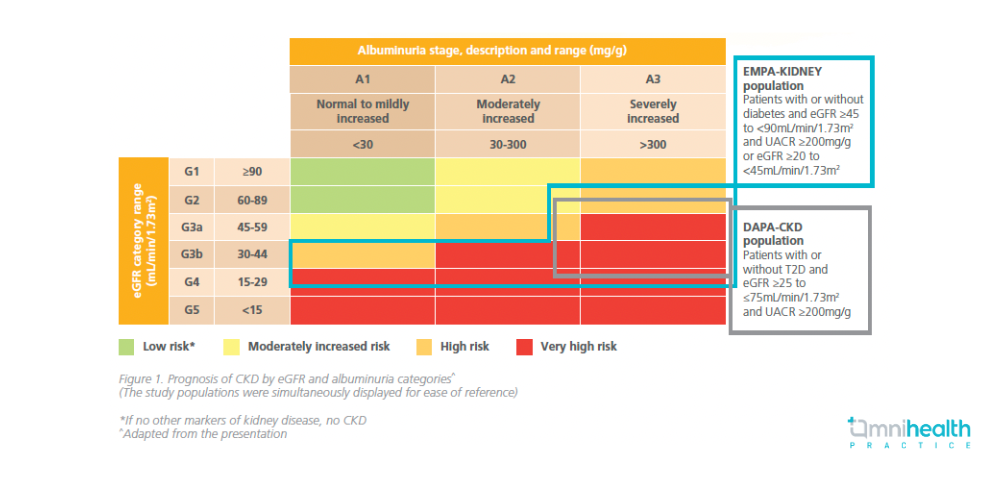
Despite encouraging findings, evidence supporting renoprotective therapies remained largely derived from populations with T2D and substantial albuminuria.5 The DAPA-CKD trial established the efficacy of dapagliflozin in patients with and without T2D across CKD stages 2-4 with increased albuminuria.17 The EMPA-KIDNEY trial further broadened the evidence base by enrolling a more diverse CKD population, including patients with and without diabetes across a wider range of kidney function and albuminuria categories (figure 1).5,17,18 In EMPA-KIDNEY, empagliflozin significantly reduced the risk of the primary composite endpoint of kidney disease progression or CV death vs. placebo (HR=0.72; 95% CI: 0.64-0.82; p<0.001), with treatment generally consistent irrespective of baseline diabetes status and eGFR.5 While primary composite event reductions were driven predominantly by patients with higher baseline albuminuria (urinary albumin-to-creatinine ratio [UACR] 300mg/g), significant attenuation of chronic eGFR decline was observed across all albuminuria categories, including norm- and microalbuminuric patients.5
Attenuating kidney function decline and modifying the trajectory of CKD
Progressive decline in eGFR is the defining characteristic of CKD and is strongly associated with CV events and premature mortality.19,20 In patients with T2D and CKD, eGFR typically declines by approximately 3-4mL/min/1.73m² per year, substantially exceeding the rate attributable to physiological aging.21 As highlighted by Prof. Yokoo, increasing evidence supports eGFR slope as a clinically meaningful surrogate endpoint, with improvements of 0.5-1.0mL/min/1.73m²/year considered indicative of meaningful slowing of CKD progression.22 Across CKD trials, greater improvements in eGFR slope correlated with larger effects on kidney outcomes and hierarchical clinical endpoints.23
Evidence from EMPA-KIDNEY demonstrated that empagliflozin consistently attenuated kidney function decline across a broad range of patients with CKD.5 Notably, empagliflozin slowed kidney disease progression across UACR categories A1, A2 and A3, indicating renoprotective benefits irrespective of baseline albuminuria status.5 Importantly, albuminuria should be regarded as a continuous marker of cardiorenal risk rather than a simple categorical variable.2 Even within the A1 category (UACR <30mg/g), progressively higher albuminuria levels are associated with stepwise increases in the risks of CKD progression, CV and all-cause mortality.2,24 Prof. Yokoo remarked, “Kidney protection and earlier intervention should therefore be considered even in the absence of overt proteinuria.” Prof. Yokoo highlighted the importance of earlier CKD detection, noting that Japan’s widespread health screening programs facilitate earlier detection, whereas CKD in Hong Kong is more often detected opportunistically and at more advanced stages.25,26 He therefore emphasized the value of UACR assessment, particularly in patients with “low” albuminuria, as even sub-A1 elevations may identify individuals who could benefit from earlier intervention.
The evidence for benefit across the CKD spectrum extends beyond albuminuria. A meta-analysis using individual-level data from 23,340 participants in four large placebo-controlled trials (EMPA-REG OUTCOME, EMPEROR-Reduced, EMPEROR-Preserved, and EMPA-KIDNEY) demonstrated consistent kidney protection irrespective of diabetes status, HF status, primary cause of kidney disease, level of albuminuria, and other markers of disease severity.27 Compared to placebo, empagliflozin reduced the relative risks of kidney failure, kidney disease progression, and acute kidney injury by 34%, 30%, and 27%, respectively, and slowed the rate of chronic eGFR decline by approximately 64%, supporting a disease-modifying effect.27
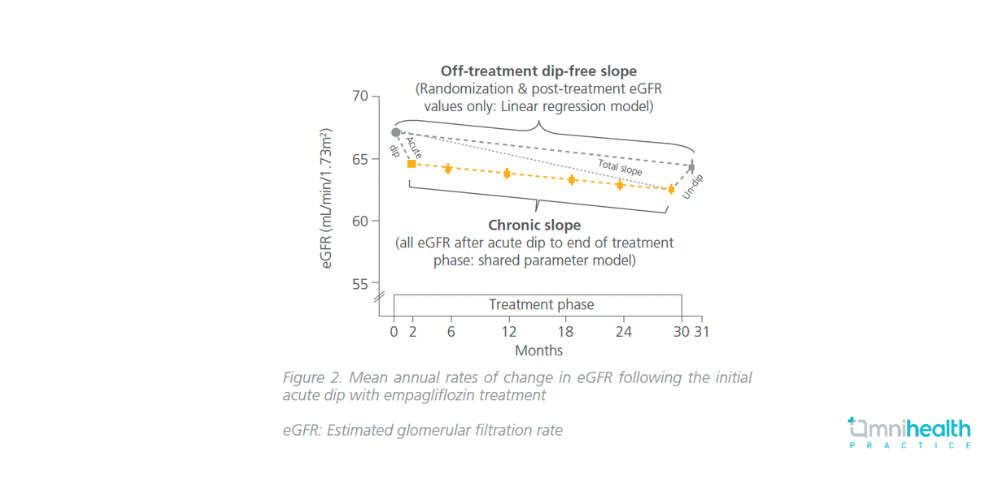
The initial eGFR dip associated with empagliflozin represents a transient, reversible hemodynamic response rather than structural injury (figure 2).27,28 The preservation of renoprotective benefit irrespective of the magnitude of the initial dip supports that this decline should not be interpreted as nephrotoxicity and does not warrant routine eGFR remeasurement or premature treatment discontinuation.18,27 Prof. Yokoo remarked: “These consistent findings support the widespread early use of empagliflozin across the CKM spectrum.”
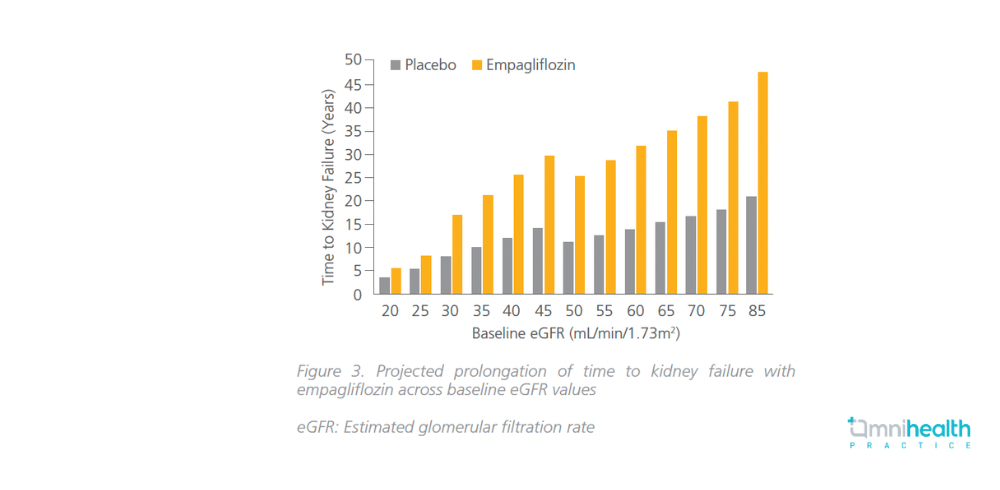
A statistical modeling analysis derived from EMPA-KIDNEY projected that empagliflozin could prolong the time to kidney failure across a broad range of baseline eGFR values (figure 3).29 While these projections are theoretical simulations extrapolated from eGFR slopes rather than long-term empirical trial outcomes, they illustrate the potential cumulative benefit of early intervention.29
International guidelines support earlier and broader implementation of SGLT2 inhibitors
Reflecting the rapidly expanding evidence base, contemporary international guidelines increasingly position SGLT2 inhibitors as foundational therapy for patients with CKD and cardiorenal risk.18,30-32 Current recommendations from KDIGO, the American Diabetes Association (ADA), and major CV societies advocate early initiation of SGLT2 inhibitors as a class in patients with T2D and CKD, HF, or established CV disease.18,30-32 These recommendations reflect a shift from glucose-centric management towards long-term cardiorenal protection and organ preservation.18,30-32 Prof. Yokoo emphasized that SGLT2 inhibitors should be considered earlier and in a broader range of patients to achieve comprehensive protection across the CKM continuum.
Conclusion
CKD should be recognized as an integral component of the CKM continuum rather than an isolated renal disorder.3,4 This paradigm supports a comprehensive approach that addresses CV, metabolic, and kidney risks together, rather than focusing on individual biomarkers in isolation.3,4 SGLT2 inhibitors have emerged as foundational therapy within this framework, with robust evidence supporting broad organ protection and earlier use in appropriate patients.18,30-32 In parallel, this paradigm shift enables general practitioners to play a greater role in early CKD detection, risk stratification, and timely referral.18 Together, these developments support earlier, integrated intervention to slow disease progression, reduce CV events, and improve long-term outcomes across the CKM continuum.5,6,12,18,30-32

