FEATURES
Shifting paradigms in CKD anemia management: Contextualizing the KDIGO 2026 guidelines in clinical practice


Chronic kidney disease (CKD) is a multifaceted global health crisis.1,2 Today, the clinical landscape has been transformed.1 Modern CKD management demands a proactive, holistic strategy that focuses heavily on slowing disease progression as early as possible, while simultaneously addressing the severe complications that degrade patient quality of life and amplify cardiovascular risk, such as anemia.1 At a recent symposium, Professor David Wheeler, an internationally recognized expert in kidney medicine from University College London, presented a lecture titled “New Era in CKD Anemia Management ” and provided profound clinical insights into this evolving paradigm, specifically addressing the intersection of disease progression and innovative anemia management strategies under the new Kidney Disease: Improving Global Outcomes (KDIGO) 2026 guidelines.\
Addressing the burden of CKD-associated anemia
Anemia in CKD is a complex condition driven by a combination of systemic iron deficiency, iron-restricted erythropoiesis, and inadequate erythropoietin (EPO) production by the failing kidneys.2 The prevalence of anemia increases stepwise as the estimated glomerular filtration rate (eGFR) declines, affecting the vast majority of patients with stage 4 and 5 CKD.2 Left unmanaged, anemia leads to profound fatigue, cognitive impairment, increased risk of left ventricular hypertrophy, and a heightened risk of cardiovascular events and mortality.2 Prof. Wheeler emphasized the importance of addressing correctable causes first. The updated KDIGO 2026 guidelines maintain a strong focus on optimizing iron stores before initiating erythropoiesis-stimulating agents (ESAs) or novel therapies, “Identify and treat potentially reversible causes of anemia, including iron deficiency,” the guidelines recommend.2 However, Prof Wheeler noted that even when patients are iron-replete, many remain profoundly anemic, necessitating targeted pharmacological intervention.
Mechanisms of action: ESAs vs. HIF-PHIs
For decades, ESAs have been the standard of care for CKD anemia.2 While effective, only half of the patients receiving ESA reach a hemoglobin (Hb) level of >10g/dL.3 Hypoxia-inducible factor prolyl hydroxylase inhibitors (HIF-PHIs), such as roxadustat, offer a novel, Nobel Prize-winning mechanism of action.3,4 Prof. Wheeler provided a clear physiological distinction: “Giving a HIF-PHI mimics hypoxia and switches on a hypoxia response that leads eventually to a coordinated increase in red cell production.“ By stabilizing the hypoxia-inducible factor (HIF), roxadustat stimulates the body’s endogenous production of EPO within a normal physiological range, while simultaneously downregulating hepcidin, the master regulator of iron homeostasis that traps iron in macrophages during states of inflammation.1,3,4
Overcoming inflammation in anemia management regardless of dialysis status
One of the most persistent clinical challenges in CKD anemia management is inflammation, which triggers a spike in hepcidin levels, leading to functional iron deficiency and resistance to standard ESA therapy.2 In the presence of inflammation, ESAs lose their efficacy, and high doses of ESAs are linked to increased cardiovascular risks.2,3 HIF-PHIs suppress hepcidin and mobilize stored iron, maintaining their efficacy even in the presence of systemic inflammation.3-6
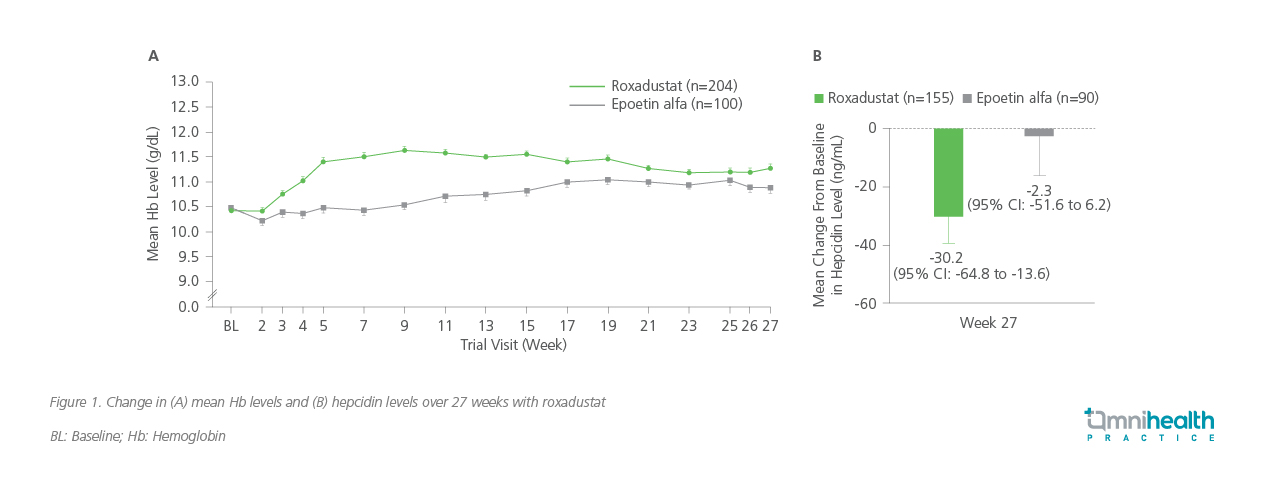
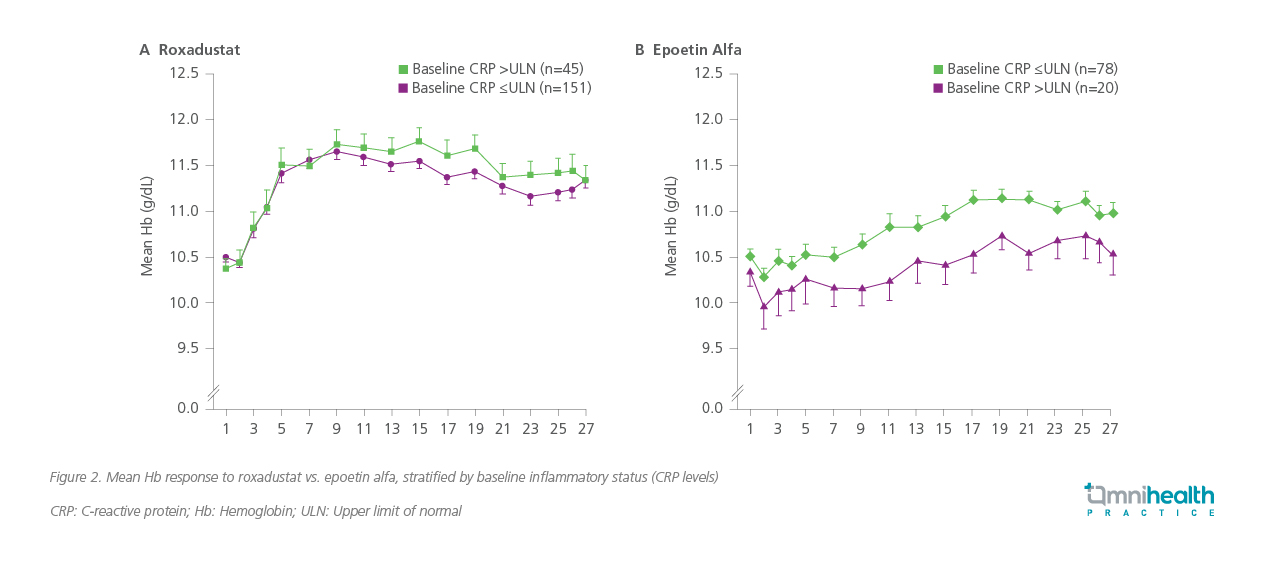
Prof. Wheeler shared compelling phase 3 trial data demonstrating this advantage.3 Regardless of whether a patient’s baseline C-reactive protein (CRP) was high or low, roxadustat consistently and predictably achieved Hb targets.3 Data from a phase 3 study in China involving 305 dialysis patients previously maintained on injectable epoetin alfa confirmed the efficacy of this oral pathway.3 Patients were randomized to receive oral roxadustat or continue parenteral standard epoetin alfa over 26 weeks.3 Hb levels increased in both groups, with roxadustat maintaining target ranges through weeks 23-27 (figure 1A).3 At the same time, roxadustat led to a marked reduction in hepcidin levels by week 27 (figure 1B), whereas epoetin alfa produced little change, indicating improved iron mobilization with roxadustat.3
The efficacy of roxadustat on Hb levels is maintained in patients with different levels of baseline inflammation.3 Patients treated with EPO who had high baseline inflammation experienced a lower and blunted Hb response compared to patients with normal CRP levels (figure 2).3 Roxadustat offers similar Hb trajectories for patients with elevated CRP (>ULN) and normal CRP (≤ULN).3 These data highlight the predictability and distinct therapeutic advantage of roxadustat in inflammatory settings, as they can effectively stimulate erythropoiesis and mobilize iron regardless of the patient's underlying inflammatory status.3
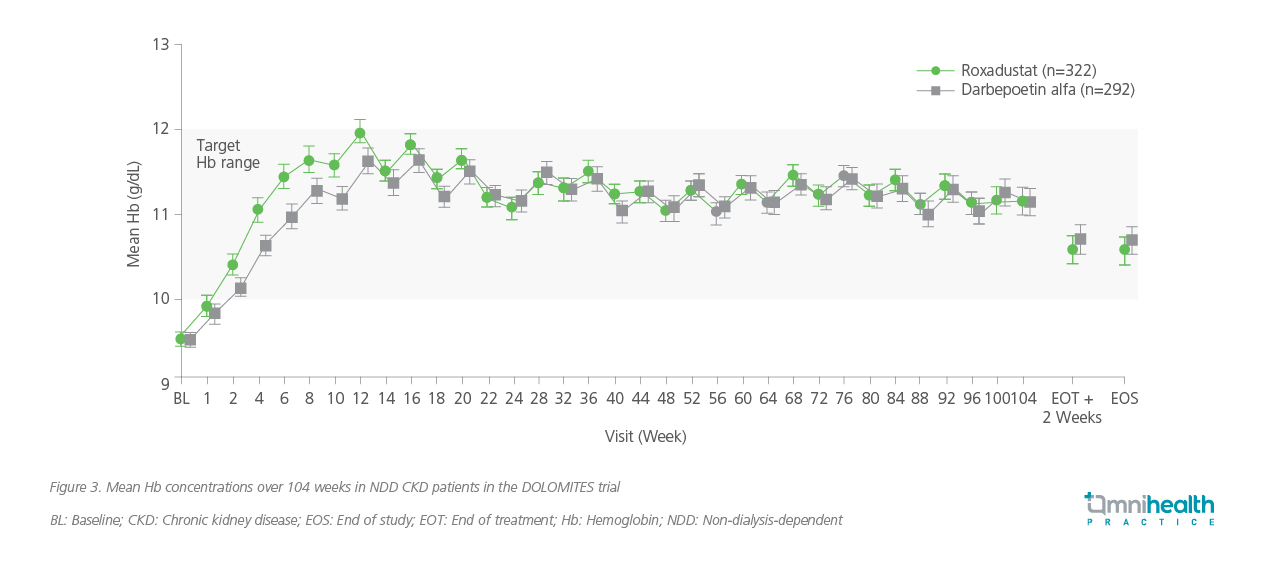
While robust evidence supports the efficacy of HIF-PHIs in overcoming inflammation for dialysis-dependent patients, their performance in earlier stages of the disease was also studied for comprehensive CKD management.3,6 To explore this therapeutic potential prior to the need for dialysis, the phase 3 DOLOMITES trial was designed to investigate the efficacy of roxadustat specifically within the non-dialysis-dependent (NDD) CKD population.6 The DOLOMITES trial enrolled patients with NDD CKD who were not receiving ESAs at the start of the study.6 The trial evaluated the efficacy of the HIF-PHI roxadustat (n=322) against an active comparator, the ESA darbepoetin alfa (n=293), for up to 104 weeks.6 The primary objective was to observe the drugs' effectiveness at achieving and maintaining Hb levels within a specific target range over the course of the study.6 While both therapies successfully achieved and maintained Hb levels within the desired target range, patients initiating roxadustat experienced a significantly steeper and faster initial rise in Hb compared to those receiving darbepoetin alfa (figure 3).6
Prof. Wheeler highlighted that with clinical trial data affirming the non-inferiority and unique physiological advantages of HIF-PHIs, the nephrology community has highly anticipated updated standardized protocols for their clinical application. Addressing this need, the updated KDIGO 2026 Clinical Practice Guideline provides a comprehensive framework, formally defining the strategic positioning and treatment algorithms for both established ESAs and novel HIF-PHIs.2
Contextualizing the 2026 KDIGO guidelines
The KDIGO 2026 guidelines introduced a highly anticipated update on the positioning of HIF-PHIs. The guideline states: “In people with anemia and CKD in whom correctable causes of anemia have been addressed, we suggest using an ESA rather than a HIF-PHI as first-line treatment of anemia (2D).“2 Prof. Wheeler, who was involved in the guideline's controversy conferences, provided context from another point of view from his professional perspective. He explained that the preference for ESAs is rooted heavily in historical timelines and clinical familiarity rather than any biological disadvantage of the newer agents.
Regarding efficacy, Prof. Wheeler emphasized that the clinical trial data consistently demonstrated HIF-PHIs to be non-inferior to ESAs across major phase 3 trials.1,3 He noted that the guideline's first-line preference for ESAs largely comes down to the volume of long-term, real-world data, as ESAs have been the standard of care for decades, whereas HIF-PHIs are relatively new entries to the global market. Prof. Wheeler commented that the committee's rationale ultimately hinged on this disparity in clinical experience, coupled with KDIGO's unique mandate to create universal recommendations adaptable across diverse global healthcare systems. He highlighted during the panel discussion that in some countries, such as the US, HIF-PHIs are not as broadly utilized as ESAs. Consequently, regional guidelines, such as those from the UK Kidney Association (UKKA) or Chinese professional bodies, may not strictly align with KDIGO in positioning HIF-PHIs as a second-line treatment, instead reflecting their own localized clinical experience and drug availability.7,8 He reassured clinicians that the KDIGO guideline is by no means a directive against using these novel therapies, but rather reflects the global nephrology community's more extensive track record with ESAs. As such, they remain a highly valuable, well-integrated tool in the modern nephrologist's armamentarium, particularly for patients who are ESA-hyporesponsive or those exhibiting high inflammatory markers.1,3
Case 1: Prioritizing iron repletion in non-dialysis CKD
To illustrate the practical application of the updated KDIGO guidelines, Prof. Wheeler presented the case of a 58-year-old male with non-dialysis CKD stage G4 and heart failure with reduced ejection fraction (HFrEF). Despite lacking overt cardiorespiratory symptoms, initial laboratory evaluation revealed a Hb level of 12.5g/dL, accompanied by markers of iron deficiency (ferritin: 26ng/mL; TSAT: 16%). In strict alignment with the 2026 KDIGO guidelines' emphasis on investigating and treating correctable causes before initiating advanced therapies, the patient was prescribed a course of intravenous iron. This targeted strategy successfully replenished his iron stores (achieving a target ferritin >100ng/mL) and stabilized his Hb levels, resolving his underlying deficiency without requiring immediate erythropoietic therapy.
Case 2: Addressing persistent anemia in hemodialysis
Demonstrating the next step in the treatment algorithm when iron optimization alone is insufficient, the second case involved a 69-year-old male with type 2 diabetes and a history of myocardial infarction who had recently initiated hemodialysis. Despite having his iron stores aggressively replete via intravenous iron sucrose (ferritin: 650ng/mL; TSAT: 46%), the patient remained persistently anemic with a Hb of 9.2g/dL. Having thoroughly addressed all correctable causes, the clinical team engaged in shared decision-making and decided to initiate the oral HIF-PHI roxadustat. By leveraging its coordinated physiological pathway, roxadustat bypassed the patient's microinflammatory state, safely and predictably correcting his Hb to a stable target of 10.5g/dL within one month.
Conclusion
The management of CKD is undergoing a profound and necessary evolution. For clinicians, the primary objective must remain firmly focused on slowing disease progression through proven therapies. Yet, as the disease advances, optimizing the management of comorbidities like anemia becomes paramount to preserving patient health and quality of life.2 The updated KDIGO 2026 guidelines reflect a transitional phase in nephrology.2 While ESAs maintain a legacy position due to their historical tenure, HIF-PHIs like roxadustat have proven their clinical non-inferiority and unique physiological advantages, particularly their ability to coordinate endogenous erythropoiesis and overcome inflammatory resistance.1-3 By applying real-world clinical wisdom, such as conservative, low-dose initiation strategies, nephrologists can safely harness the full potential of these novel therapies, ushering in a new era of personalized, effective, and holistic CKD care.
HK-13300 10/09/2026