CONFERENCE UPDATE: ACC 2026
Evolocumab reduces first MACE in high-risk patients without established atherosclerosis: Subgroup analysis from the VESALIUS-CV trial


STUDY DESIGN
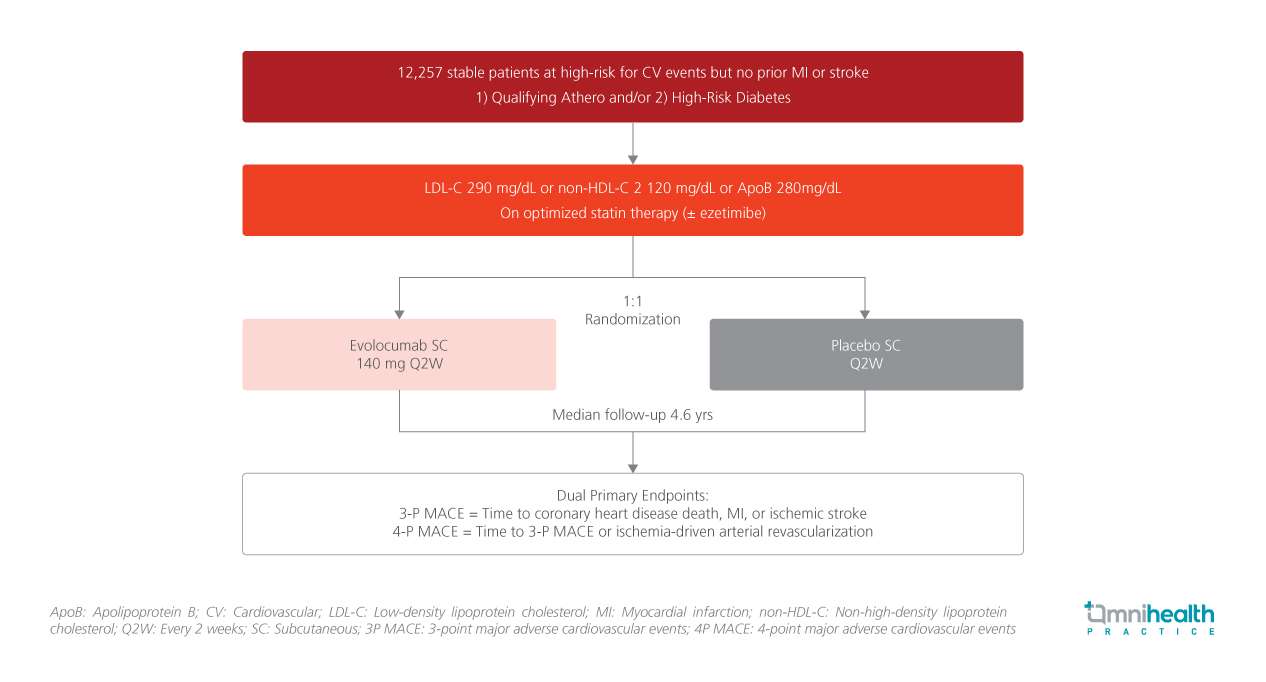
VESALIUS-CV was a randomized, double-blind, placebo-controlled, multicenter trial conducted across 33 countries that enrolled 12,257 patients to evaluate the impact of evolocumab on major adverse cardiovascular events (MACE) in patients at high cardiovascular (CV) risk without prior myocardial infarction (MI) or stroke.1
Eligible patients were required to have elevated atherogenic lipids, defined as low-density lipoprotein cholesterol (LDL-C) ≥90mg/dL, non-high-density lipoprotein cholesterol (non-HDL-C) ≥120mg/dL, or apolipoprotein B (ApoB) ≥80mg/dL, despite optimized lipid-lowering therapy (LLT) with or without ezetimibe, and had either established atherosclerosis or high-risk diabetes.1 Patients were randomized 1:1 to receive subcutaneous evolocumab 140mg every two weeks or a matching placebo, on top of optimally tolerated statin therapy, and were followed for a median of 4.6 years.1
The present prespecified subgroup analysis focused on 3,655 patients (30% of the overall VESALIUS-CV population) without established significant atherosclerotic disease to assess whether evolocumab could prevent a first MACE in this lower-risk subgroup.1 Significant atherosclerosis was defined as prior arterial revascularization, documented arterial stenosis ≥50%, and a coronary artery calcium (CAC) score ≥100 Agatston units.1 Per protocol, all patients had high-risk diabetes mellitus, defined by a disease duration of ≥10 years, daily insulin use, or the presence of microvascular complications.1
Baseline characteristics within the prespecified subgroup were generally well balanced between treatment groups, with a median age of 65 years and 57% of participants being female.1 Hypertension was present in 88% of patients, with a median body mass index (BMI) of 31kg/m2 and a median LDL-C level of 132mg/dL.1 At baseline, 89% of patients were receiving any LLT, with statins used in 84% and ezetimibe in 14%.1 Of these, 68% were already treated with high-intensity LLT.1
The dual primary endpoints were 3-point MACE (time to coronary heart disease death, MI, or ischemic stroke) and 4-point MACE (time to 3-point MACE or ischemia-driven arterial revascularization).1 Secondary endpoints included composite outcomes of MI, stroke, ischemia-driven revascularization (IDR), and coronary heart disease (CHD)/CV death, along with all-cause mortality.1
FINDINGS
|
Primary endpoints: |
|
|
Secondary and exploratory endpoints: |
|
“These data strongly support that in these lower-risk patients, we should be targeting LDL-C goals typically reserved for very high-risk secondary prevention patients.”
Dr. Nicholas Marston
Brigham and Women’s Hospital, Boston, United States