CONFERENCE UPDARE: EHA 2026
PET-guided BrECADD delivers durable disease control and tolerability in older AS-cHL patients: Final HD21 analysis


Unmet clinical needs in older patients with AS-cHL
Older patients with advanced-stage classical Hodgkin lymphoma (AS-cHL) continue to experience poorer outcomes, largely owing to a greater burden of comorbidities, poorer performance status, biologic differences, and limited tolerance to intensive chemotherapy.1 Despite substantial improvements in disease control achieved with modern frontline therapies, treatment selection in older patients with AS-cHL remains challenging.1,2 Intensified regimens often improve tumor control at the expense of severe toxicity, whereas less intensive approaches frequently compromise long-term disease control and survival outcomes.1,2
HD21 trial: Establishing PET-guided BrECADD in younger patients
The phase 3 HD21 trial conducted by the German Hodgkin Study Group (GHSG) represents an important milestone in the treatment of AS-cHL.3 In the pivotal study involving patients aged 18-60 years, positron emission tomography (PET)-guided brentuximab vedotin, etoposide, cyclophosphamide, doxorubicin, dacarbazine, and dexamethasone (BrECADD) was compared with PET-guided escalated bleomycin, etoposide, doxorubicin, cyclophosphamide, vincristine, procarbazine, and prednisone (eBEACOPP ).3 BrECADD significantly reduced treatment-related morbidity (TRMB), with rates at 59% in the eBEACOPP arm vs. 42% in the BrECADD arm (relative risk [RR]=0.72; 95% CI: 0.65-0.80; p<0.0001).3 Importantly, this improvement in tolerability was accompanied by excellent disease control, with four-year progression-free survival (PFS) rates of 94.3% (95% CI: 92.6-96.1) for BrECADD vs. 90.9% (95% CI: 88.7-93.1) for eBEACOPP, establishing BrECADD as a highly effective frontline treatment option for younger patients with AS-cHL.3
Whether the favorable efficacy and safety outcomes could be replicated in older adults remained uncertain.3 Patients aged >60 years are often excluded from intensive treatment strategies because of toxicity concerns, and prospective evidence supporting modern frontline regimens in this age group remains limited.3 To address this evidence gap, the GHSG initiated the HD21 Older Cohort, a prospective, international, multicenter, single-arm add-on to the HD21 trial.4
Study design of the add-on HD21 Older Cohort
The study evaluated the efficacy, safety, and feasibility of PET-guided BrECADD in patients aged 61-75 years with newly diagnosed AS-cHL, using complete response (CR) at the end of chemotherapy as the primary endpoint.4 Patients received two cycles of BrECADD followed by centrally reviewed interim PET imaging (PET2).4 PET2-negative patients completed a total of four cycles of therapy, whereas PET2-positive patients completed six cycles.4 Consolidative radiotherapy (30 Gy) to residual PET-positive lesions was recommended after chemotherapy.4 Secondary endpoints included PFS, overall survival (OS), time to progression (TTP; censoring deaths without prior progression), secondary malignancies, and late toxicities.4 The data cut-off for this analysis was October 1, 2025.4
The intention-to-treat and safety populations included 83 patients reflecting a frail, clinically challenging real-world cohort: median age was 67 years (range: 61-75), 87% had ≥1 comorbidity (mean Cumulative Illness Rating Scale-Geriatric [CIRS-G] score: 3.7), and nearly half were unfit or frail. Additionally, 73% had an International Prognostic Score (IPS) ≥3.4
High treatment feasibility and completion rates in PET-guided BrECADD
Despite the advanced age and comorbidity burden of the cohort, PET-guided BrECADD demonstrated a high degree of treatment feasibility.4 Among the 80 patients who received PET-based panel recommendations, the majority achieved complete remission following interim assessment and were assigned to receive only four cycles of therapy.4 Overall treatment completion reached 89%, with few premature discontinuations due to toxicity or consent withdrawal.4 While lower than the 98% completion rate in the younger HD21 population, this demonstrates strong feasibility in a vulnerable population historically limited by excess toxicity and treatment-related mortality.1,3,4
Early metabolic response and tumor burden reduction
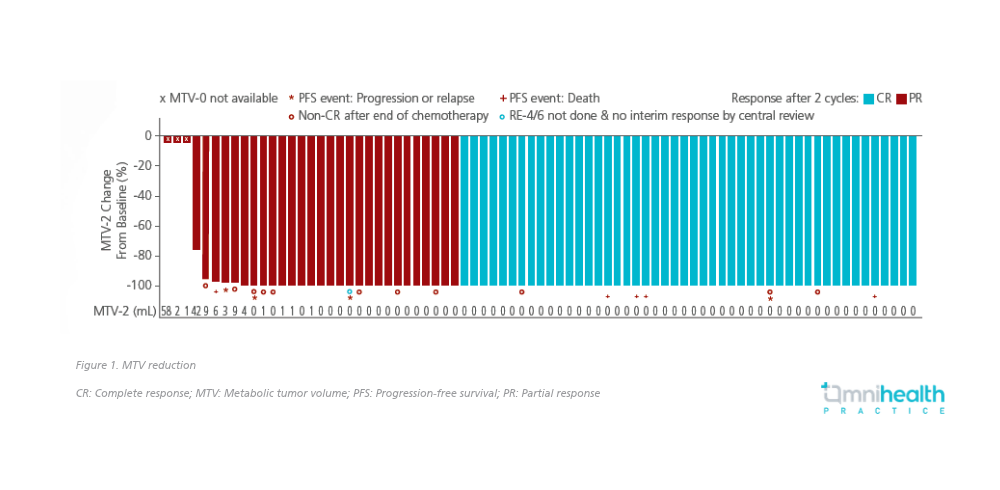
Assessment of metabolic tumor volume (MTV) demonstrated rapid tumor burden reduction after two treatment cycles.4 Complete MTV clearance was achieved in 76% of evaluable patients (n=60) after cycle two (figure 1), including individuals presenting with high baseline tumor burden.4 These rapid responses are clinically meaningful, as early PET negativity strongly correlates with long-term survival in Hodgkin lymphoma and underpins established PET-adapted frameworks such as HD18 and RATHL.5-7
Durable disease control and long-term survival outcomes
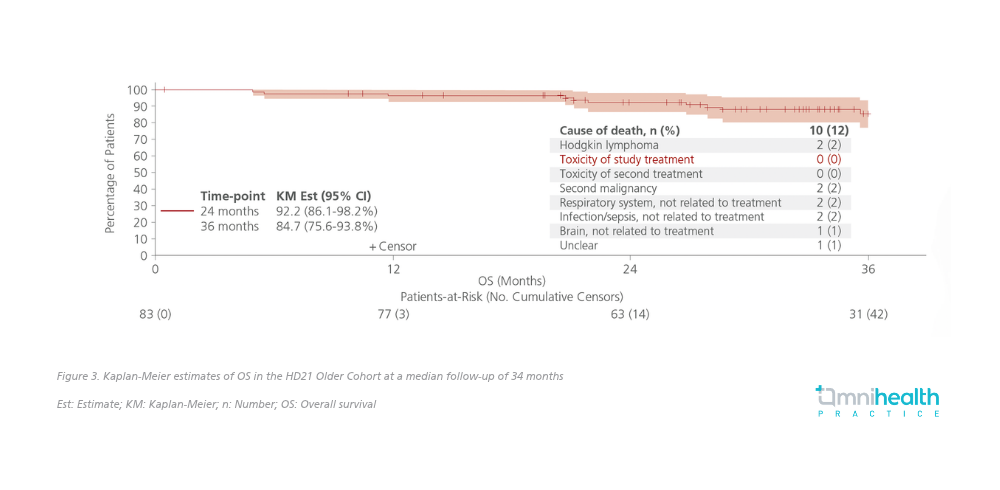
At a median follow-up of 34 months, BrECADD demonstrated durable disease control across key efficacy endpoints.4 PFS was estimated at 92.3% (95% CI: 86.4-98.2) at 24 months and 83.2% (95% CI: 73.7-92.7) at 36 months (figure 2).4 OS rates reached 92.2% at 24 months and 84.7% at 36 months (figure 3), highlighting the ability of PET-guided BrECADD to achieve sustained long-term survival benefit in this older population.4 Notably, only two deaths were directly attributed to Hodgkin lymphoma, suggesting effective disease control throughout follow-up.4
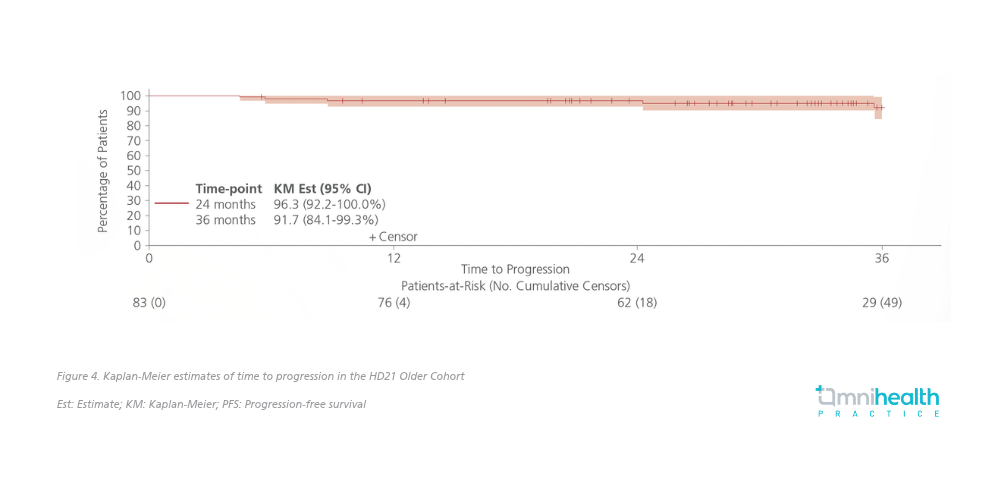
The TTP analysis provided further evidence of durable remissions, with estimated TTP rates of 96.3% (95% CI: 92.2-100.0) at 24 months and 91.7% (95% CI: 84.1-99.3) at 36 months (figure 4).4 These findings affirm that the majority of older patients achieved durable disease control despite adverse baseline characteristics.4
Favorable safety profile and tolerability of PET-guided BrECADD
Long-term safety was a key focus of the final analysis.4 Importantly, no deaths were attributed to study treatment toxicity.4 Among the ten deaths reported during follow-up, causes included Hodgkin lymphoma (n=2), second malignancies (n=2), unrelated infection or sepsis (n=2), unrelated respiratory conditions (n=2), and other unrelated causes.4 The absence of treatment-related mortality contrasts favorably with historical outcomes in older populations treated with intensive chemotherapy.3
Peripheral neuropathy, a known risk with brentuximab vedotin, was carefully monitored throughout follow-up.4,8 Although neuropathy occurred during treatment, 89% of patients experienced recovery during follow-up, and no persistent grade 2 neuropathy was reported at study closure.4
Organ function (cardiac, pulmonary, renal, and thyroid) remained stable between baseline and end-of-treatment without meaningful deterioration.4 Minimizing acute and late toxicities is critical for preserving quality of life in older adults.9,10 Secondary malignancies occurred in 12 patients (7 hematological, 4 solid tumors).4 Notably, no cases of acute myeloid leukemia (AML) or myelodysplastic syndromes (MDS) were reported.4
Conclusion
The final analysis of the HD21 Older Cohort provides prospective evidence supporting PET-guided BrECADD in patients aged 61-75 years with newly diagnosed AS-cHL.4 Despite substantial comorbidities, frailty, and adverse prognostic features, the regimen demonstrated high feasibility, deep metabolic remissions, durable PFS and OS, preserved organ function, and zero treatment-related mortality.4 These results extend the findings of the main HD21 trial to older adults, addressing a longstanding evidence gap and supporting PET-guided BrECADD as a standard frontline option across a broader age spectrum.3,4

