FEATURES
Rethinking unexplained LVH: Enhancing Fabry diagnosis in Hong Kong with the potential of AI


Fabry disease remains significantly underdiagnosed in Hong Kong, despite emerging data showing meaningful prevalence among high‑risk cardiac patients.1,2 Many individuals experience subtle or nonspecific symptoms for years, leading to delayed recognition and missed opportunities for early treatment.1 The predominance of the IVS4 late‑onset cardiac variant in East Asian populations further complicates timely detection, often masking Fabry disease as more common cardiac conditions.1,2 In a recent interview with Omnihealth Practice, Dr. Lee, Pui‑Wai Alex, provided an in‑depth exploration of the Fabry disease landscape in Hong Kong, covering the diagnostic challenges, current protocols, and the future role of artificial intelligence (AI) in screening. He highlighted that in recent years, Hong Kong’s medical community has made substantial progress in raising awareness and implementing diagnostic pathways, and that early diagnosis, which enables timely treatment, is essential to reducing long‑term organ damage and improving overall outcomes for patients.
Fabry disease: Unmasking a hidden threat
Fabry disease is a rare, X-linked lysosomal storage disorder caused by pathogenic variants in the GLA gene, which result in a deficiency or absence of the alpha-galactosidase A (α-Gal A) enzyme.1,2 This enzymatic defect leads to the progressive, systemic accumulation of glycosphingolipids, predominantly globotriaosylceramide (Gb3) and its deacylated derivative, lyso-Gb3, within the lysosomes of various cells, ultimately precipitating irreversible, multiorgan dysfunction.1,2
The classical Fabry disease involves near-complete loss of α-Gal A enzyme activity, leading to early-life onset of multisystem symptoms and progressive complications such as neuropathic pain, gastrointestinal issues, visual disturbances, left ventricular hypertrophy (LVH), arrhythmias, kidney failure, stroke, and respiratory problems.2,3 In contrast, the later-onset Fabry disease retains partial enzyme activity, with symptoms—primarily cardiac and renal—emerging in middle age or later.2,3
The clinical landscape of Fabry disease in Hong Kong
While inherited metabolic diseases (IMDs) collectively represent a significant healthcare burden, individual conditions like Fabry disease are often overlooked in routine clinical practice, particularly within Asian populations.2,4 The disease affects up to approximately 1 in 40,000 people worldwide, with higher prevalence in some Asian populations.1,2 Historically, an accurate portrayal of the prevalence of Fabry disease has been limited, but emerging testing algorithms have managed to increasingly accurately identify Fabry disease.1
Recent epidemiological efforts, such as the Asian Fabry Cardiomyopathy High-Risk Screening Study 2 (ASIAN-FAME-2) conducted in Hong Kong, have shed critical light on the local burden of the disease.1 By screening patients with unexplained LVH, researchers revealed the presence of a hidden pool of undiagnosed Fabry disease patients in Hong Kong whose primary presentation is cardiovascular rather than classical metabolic disease.1 In particular, these patients present with the late-onset cardiac variant of Fabry disease with a GLA c.640-801G>A mutation, which remains the most common cause of Fabry disease among local populations.1
Dr. Lee highlighted that “Hong Kong typically identifies fewer than 10 new cases per year,” a number far below what prevalence studies would predict.2 Such a discrepancy strongly indicates that a substantial portion of Fabry disease cases remain undetected within the community.2 Given the progressive nature of the disease and the irreversible complications that can develop without timely intervention, improving early awareness remains a key public health priority.5 Once Fabry disease is correctly and timely identified, appropriate treatment can prevent irreversible tissue damage.5
Navigating the clinical labyrinth: Overcoming diagnostic challenges
The diagnostic odyssey for a patient with Fabry disease is notoriously prolonged, often spanning 2 to 18 years from symptom onset to a definitive diagnosis.2 This delay is primarily attributed to the disease's diverse, non-specific presentation and the varying degrees of organ involvement.2 Dr. Lee cautioned that “If a cardiologist isn't specifically looking for Fabry disease, they won't order the genetic tests or enzyme assays needed to find it. They might just treat the symptoms without knowing the cause.” The clinical suspicion of Fabry disease should be triggered by a constellation of “red flag“ symptoms.2 In childhood, these often include acroparesthesia, angiokeratomas, hypohidrosis, and unexplained gastrointestinal disturbances such as chronic abdominal pain and diarrhea.2 As the patient ages, the progressive accumulation of glycolipids leads to life-threatening complications, notably Fabry nephropathy (proteinuria and declining glomerular filtration rate), hypertrophic cardiomyopathy, and early-onset cerebrovascular events like transient ischemic attacks or strokes.2
The critical window: Why early diagnosis changes the disease trajectory
The fundamental importance of early diagnosis in Fabry disease cannot be overstated. Dr. Lee emphasized that “We rarely see the heart return to a completely “normal“ state once damage has occurred. That’s why diagnosing before the heart thickens or scars is the only way to truly change the patient's life.” The pathophysiology of the disease is a continuous cascade; cellular damage accumulates, organ damage becomes clinically apparent, and potentially structurally irreversible (figure 1).5,6
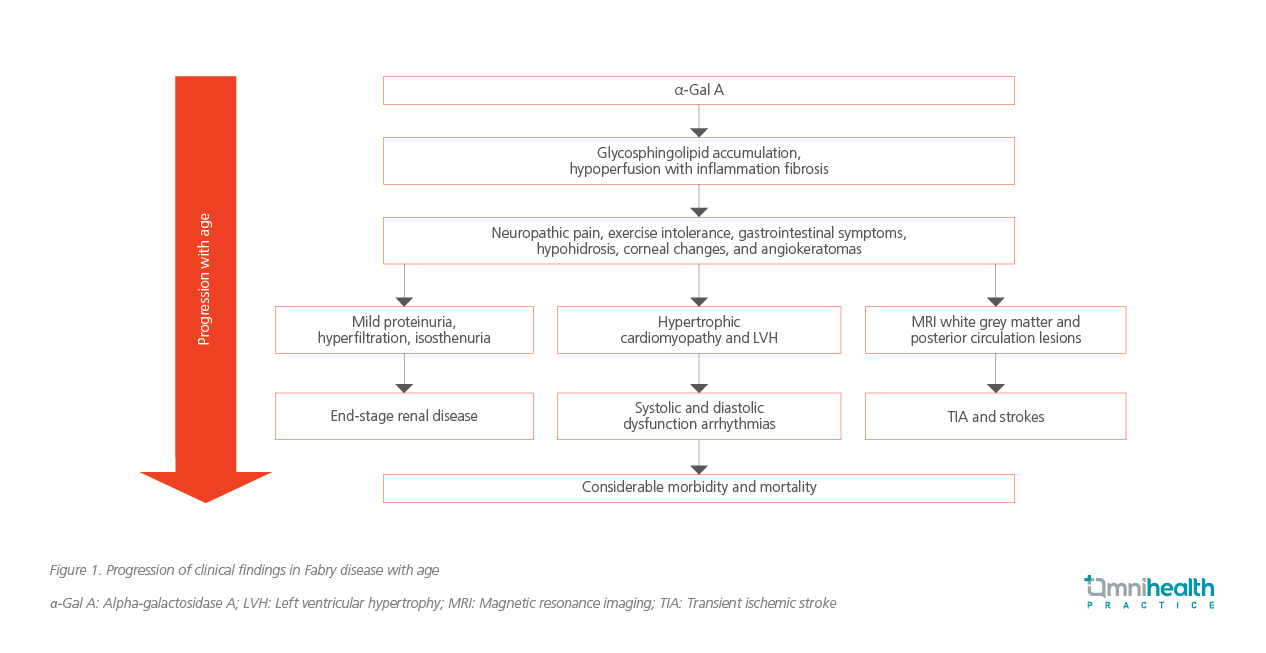
Timely diagnosis offers a critical window of opportunity to initiate disease-modifying treatments before the onset of permanent tissue fibrosis.3 Furthermore, because Fabry disease is an inherited X-linked condition, the diagnosis of a single “index patient“ has profound implications for an entire family.3 Comprehensive pedigree analysis and family screening can uncover multiple undiagnosed, asymptomatic, or mildly affected relatives, allowing for early monitoring and proactive intervention across generations.3 By transitioning from a reactive, symptom-based approach to a proactive, diagnostic-centric model, clinicians can drastically alter the natural history of the disease and improve patient outcomes.3
Current testing modalities for Fabry disease
Confirming the diagnosis requires a multifaceted approach, combining biochemical, genetic, and imaging tests based on the patient’s biological sex to confirm the condition and assess organ involvement.1,3,7-9 These include enzyme activity assays, genetic testing (GLA mutation analysis), biomarker testing (lysoGb3), advanced cardiac imaging, and tissue biopsy.1,3,7-9
The primary tests involve measuring α-Gal A enzyme activity and molecular genetic analysis of the GLA gene (figure 2).2 The initial screening often involves measuring α-Gal A enzyme activity.3 In hemizygous males, the gold standard for laboratory diagnosis is the demonstration of deficient α-Gal A enzyme activity.7 However, evaluating heterozygous females presents a unique clinical challenge.7 Due to random X-chromosome inactivation, most female patients may exhibit normal α-Gal A activity despite harboring a pathogenic mutation.3,8,9 Limitations of enzyme assays in women led to molecular genetic analysis of the GLA gene, which remains the gold standard for a definitive diagnosis.3,8,9 It identifies specific pathogenic mutations, guiding familial screening and risk stratification.3,8,9 Biomarker testing, such as that of globotriaosylsphingosine (lysoGb3), is a highly sensitive blood biomarker analyzed via mass spectrometry.10 It is significantly elevated in patients with classic Fabry disease and helps distinguish clinically patients.10 Crucially, lysoGb3 levels can identify affected women who present with normal enzyme activity.10
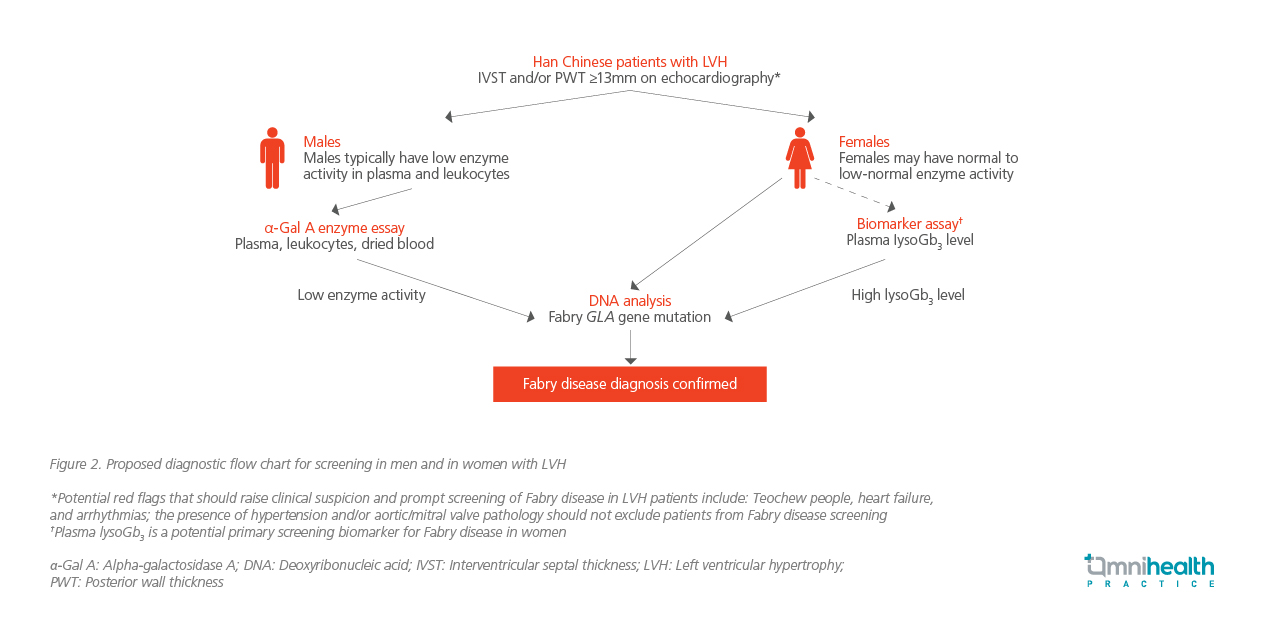
Other imaging and biopsies serve to offer additional information for making clinical decisions. Echocardiography with strain imaging is used to identify hallmark features like concentric left ventricular (LV) wall thickness, reduced longitudinal strain, and prominent papillary muscles.3 In cases where genetic and biochemical findings are equivocal, renal or cardiac biopsies may be performed.3
Harnessing AI: A new frontier in the early detection of rare diseases
Given the inherent difficulties in diagnosing rare diseases, innovative technologies are increasingly being leveraged to bridge the gap between clinical presentation and accurate identification. In the interview, Dr. Lee shared that AI is emerging as a powerful adjunctive tool in this domain. Recent advancements include the integration of medical expert knowledge into AI-powered symptom checkers.11 By embedding complex, expert-derived clinical vignettes into these AI models, researchers have significantly enhanced diagnostic accuracy for Fabry disease.11 In clinical pilot studies, optimized AI symptom checkers successfully flagged Fabry disease as a top diagnostic suggestion in some complex cases, demonstrating their potential to alert primary care physicians to rare diagnoses that might otherwise be entirely overlooked.11 Certain cardiac diseases closely resemble Fabry disease on imaging—most notably cardiac amyloidosis and hypertrophic cardiomyopathy.12 AI algorithms can analyze imaging data to distinguish between these conditions based on wall thickness distribution, myocardial strain patterns, and tissue density characteristics.12 Such differentiation is critical for patients to receive the correct treatment.
Dr. Lee shared that, “The goal is a more confident diagnosis: you feed the AI an echocardiogram, and it gives you a probability score for Fabry disease. This helps streamline the process of human suspicion which is often the biggest bottleneck.” By acting as a high-sensitivity screening tool, AI applications may be able to prevent missed diagnoses and ensure patients are triaged to appropriate metabolic care much earlier in their disease course.12 Future AI platforms may provide automated scoring for Fabry disease probability, multi-parameter analysis integrating imaging, echocardiogram, and clinical data, and alerts recommending genetic testing or specialist referral.12 Although the technology for Fabry disease is still in development, Dr. Lee remains optimistic and likened it to the research from local research where AI algorithms have been used to identify amyloid plaques and Alzheimer’s disease.13
Conclusion
Fabry disease is a progressive, devastating condition that requires a high index of clinical suspicion to overcome its inherent diagnostic challenges.2 As the prevalence of the disease becomes clearer in populations such as Hong Kong's, the mandate for early and accurate diagnosis becomes increasingly urgent.1,2,5 Dr. Lee highlighted that “By using AI as a preliminary filter, doctors can more efficiently identify high-risk individuals who should undergo definitive genetic testing, thereby reducing the decades-long delay some patients face before receiving a correct diagnosis.” Ultimately, establishing a timely diagnosis is the critical first step toward initiating life-altering therapies like agalsidase alfa, ensuring that patients receive the targeted, comprehensive care required.3
C-ANPROM/HK/REP/0027(06/2026)