CONFERENCE UPDATE: ACC 2026
The phase 3 SCOUT-HCM trial shows mavacamten significantly improves LVOT obstruction in adolescents with HCM


STUDY DESIGN
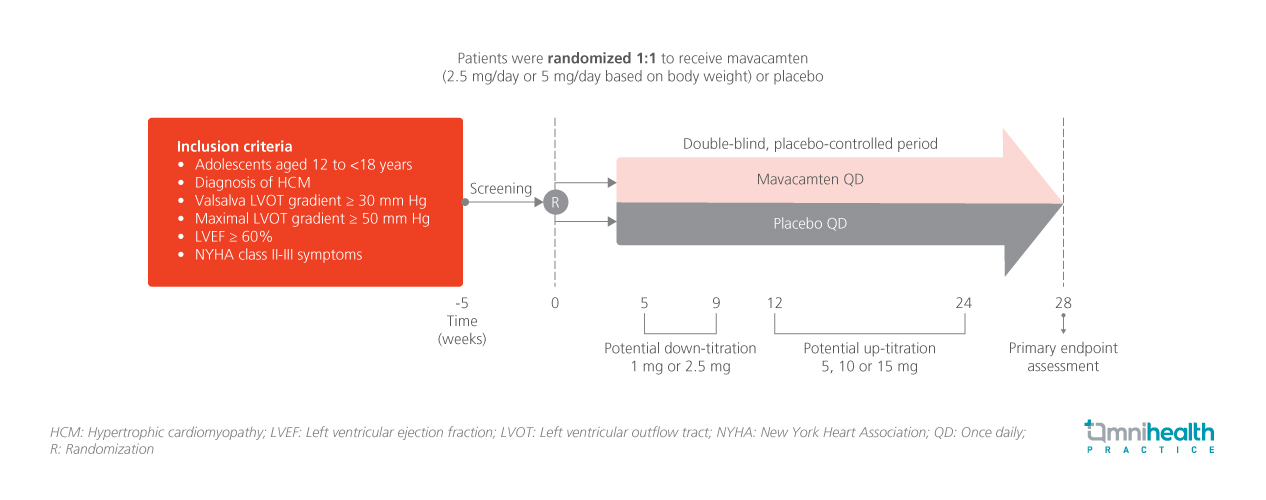
Mavacamten, a selective cardiac myosin inhibitor approved for adults with symptomatic obstructive hypertrophic cardiomyopathy (HCM), has not previously been studied in a pediatric cohort.1 SCOUT-HCM is a phase 3, randomized, double-blind, placebo-controlled trial, designed to evaluate the efficacy and safety of mavacamten in adolescents with symptomatic obstructive HCM.1 The study enrolled 44 patients aged 12 to <18 years with a confirmed diagnosis of HCM.1 Eligible participants were required to have a Valsalva left ventricular outflow tract (LVOT) gradient ≥30mmHg, a maximal LVOT gradient ≥50mmHg, a left ventricular ejection fraction (LVEF) ≥60%, and New York Heart Association (NYHA) class II-III symptoms.1
Patients were randomized 1:1 to receive mavacamten once daily or a matching placebo during a 28-week treatment period.1 Weight-based dosing was used at study initiation, with patients receiving either 5mg daily (body weight ≥45kg) or 2.5mg daily (body weight ≥35kg to <45kg).1 Dose adjustments were permitted during the trial, with potential down-titration to 1mg and up-titration to 15mg based on clinical and echocardiographic parameters.1 Baseline characteristics were generally balanced between groups, including age, mutations, LVOT gradient, and background beta-blocker therapy.1 Baseline biomarker levels were higher in the mavacamten group, with median NT proBNP 1,776pg/mL vs. 1,294pg/mL in the placebo group, high-sensitivity cardiac troponin I (hs-cTnI) 36.1pg/mL vs. 22.7pg/mL, and high-sensitivity cardiac troponin T (hs-cTnT) of 25.3pg/mL vs. 16.7pg/mL.1
The primary endpoint was the change from baseline to week 28 in Valsalva LVOT gradient.1 Secondary efficacy endpoints included changes in resting and post-exercise LVOT gradients, maximal left ventricular (LV) wall thickness, E/e’ ratio, and symptom burden measured by the HCM Symptom Questionnaire Shortness of Breath (HCMSQ SoB) domain.1 Additional analyses evaluated the proportion of patients achieving maximal LVOT gradient reduction to <30mmHg, improvement of ≥1 NYHA class, improvement of ≥1 mitral regurgitation grade, or increased peak oxygen consumption.1 Safety endpoints included the incidence of treatment-emergent adverse events (TEAEs), treatment-emergent serious adverse events (TESAEs), reductions in LVEF <50% or ≤30%, and changes in QT interval on electrocardiography.1
FINDINGS
|
Primary endpoint: |
|
|
Secondary endpoints: |
|
|
Safety: |
|
“Mavacamten demonstrates clinically meaningful and statistically significant reductions in Valsalva LVOT gradient, alongside broad improvements in obstruction, symptoms, and cardiac function, supporting its role for symptomatic obstructive HCM in adolescents.”
Dr. Joseph Rossano
Children’s Hospital of Philadelphia, Pennsylvania, United States