INDUSTRY ESSENTIALS
Optimizing knee OA management: Expert consensus from the Hong Kong College of Orthopaedic Surgeons


Knee osteoarthritis (OA) is one of the most common musculoskeletal disorders among middle-aged and older adults.1 Its incidence rises with age, and with Hong Kong’s rapidly aging population, among the longest living societies globally, the number of individuals affected by knee OA is projected to surge in the coming decades.1 This highlights the urgent need for effective management strategies in Hong Kong, with clear, evidence-based recommendations to improve patient outcomes locally.1,2
To provide practical, evidence-based guidance tailored to Hong Kong, the Hong Kong College of Orthopaedic Surgeons (HKCOS) issued a position statement on knee OA management in 2022, based on an expert consensus survey of 106 fellows and a review of high-quality evidence in the literature.2 The recommendations were reaffirmed in a 2024 follow-up survey involving 28 fellows.1 Consensus was defined as a minimum of 70% agreement among the expert panellists and was consistently reached for key treatment approaches across both 2022 and 2024 surveys.1 Table 1 summarizes the interventions recommended, not recommended, or for which there is insufficient evidence to advocate for or against, as outlined in the position statement.3
The management of knee OA aims to achieve two objectives: (1) slow disease progression by addressing modifiable risk factors (e.g. weight reduction and prevention of knee injury), and (2) control symptoms, usually with the focus on pain management and improvements in quality of life.1,2 Reflecting these principles, the HKCOS consensus highlights a stepwise, evidence-based, biopsychosocial approach in Hong Kong, with non-pharmacological measures forming the foundation, and pharmacological or surgical options reserved for later or end-stage disease.2 These recommendations are generally aligned with international guidelines such as those of the National Institute for Health and Care Excellence (NICE), the American Academy of Orthopaedic Surgeons (AAOS), and the Osteoarthritis Research Society International (OARSI), while also reflecting the distinctive local context where traditional Chinese medicine plays a notable role in patient care.1,4-6
The HKCOS position statement offers evidence-based guidance for the management of OA in Hong Kong, reflecting expert consensus and local considerations.1 Its implementation can support standardization of care and inform clinical practice, addressing the increasing prevalence of knee OA in the region.1
|
Category |
Recommendation |
Agreement (2022, 2024) |
|
Non-pharmacological interventions |
||
|
Recommended |
Patient education |
100%, 100% |
|
Land-based exercise |
99%, 86% |
|
|
Water-based exercise |
91%, 86% |
|
|
Self-management program |
83%, 86% |
|
|
Weight reduction for high BMI patients |
97%, 100% |
|
|
Cane use |
90%, 96% |
|
|
Not recommended |
Lateral wedge insoles |
78%, 82% |
|
Unable to advocate for/against |
Thermotherapy |
67%, 68% |
|
TENS |
33%, 32% |
|
|
PENS/PEMF therapy |
43%, 43% |
|
|
Acupuncture |
26%, 32% |
|
|
Valgus off-loading knee braces |
22%, 7% |
|
|
Knee sleeve |
28%, 29% |
|
|
Pharmacological interventions |
||
|
Recommended |
Paracetamol as a first-line analgesic |
92%, 96% |
|
Topical NSAIDs as first-line therapy |
78%, 86% |
|
|
Oral NSAIDs (+PPIs) as second-line treatment (with precautions) |
96%, 100% |
|
|
Unable to advocate for/against |
Opioid analgesics |
40%, 32% |
|
Intra-articular steroid injections for short-term pain relief |
31%, 43% |
|
|
Intra-articular hyaluronic acid injections |
60%, 54% |
|
|
Intra-articular platelet-rich plasma injections |
25%, 32% |
|
|
Oral supplements (glucosamine, chondroitin, vitamin D) |
34%, 32% |
|
|
Surgical interventions |
||
|
Recommended |
High tibial osteotomy in selected patients with medial compartment OA |
74%, 75% |
|
Knee arthroplasty for symptomatic end-stage OA after failed non-operative management |
99%, 100% |
|
|
Not recommended |
Denervation therapy |
77%, 82% |
|
Arthroscopic lavage and debridement |
76%, 64% |
|
|
Unable to advocate for/against |
Partial meniscectomy |
33%, 36% |
Table 1. HKCOS position statements on the management of knee OA
HKCOS: Hong Kong College of Orthopaedic Surgeons; NSAIDs: Non-steroidal anti-inflammatory drugs; OA: Osteoarthritis; PEMF: Pulsed electromagnetic field therapy; PENS: Percutaneous electrical nerve stimulation; PPI: Proton-pump inhibitor; PRP: Platelet-rich plasma; TENS: Transcutaneous electrical nerve stimulation
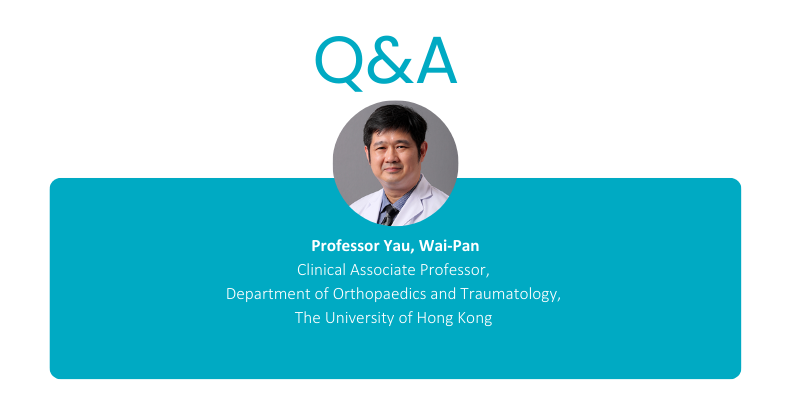
In an interview with Omnihealth Practice, Professor Yau, Wai-Pan, an esteemed orthopedic surgeon, shared his insights on advancing OA management and future therapeutic directions.
Q1. How can clinicians improve patient adherence to foundational OA treatments like exercise and weight loss?
Professor Yau: Improving adherence to foundational OA treatments hinges on effective education and realistic expectation management. For exercise, emphasize regularity over intensity by advising 15-30 minutes of daily simple stretching, lower limb muscle strengthening exercises, or walking routines. Inform patients that visible benefits may take months to appear and that initial pain from overexertion is common; counsel them to rest for 1-2 days before resuming at a lower intensity. In Hong Kong, referring to physiotherapy can enhance engagement by introducing varied exercises. For weight management, the focus should be on obese patients, for whom a practical and achievable initial goal is to prevent further weight gain, which can serve as a stepping stone to eventual weight loss.
Q2. Despite their widespread use, why do intra-articular injections for OA remain a contentious topic among clinicians?
Professor Yau:The lack of consensus arises from inconsistent scientific evidence, with studies on treatments like oral supplements and intra-articular hyaluronic acid often being small-scale, conflicting, or showing minimal effects. While intra-articular steroid injections provide effective short-term symptomatic relief, many surgeons use them cautiously due to the potential risk of elevating post-operative infection rates if patients later require total joint replacement. As a result, orthopedic surgeons are especially reluctant to administer them to those on surgical waiting lists or likely to need surgery soon.
Q3. What is the rationale for recommending paracetamol as a first-line agent for OA in Hong Kong?
Professor Yau: The recommendation is primarily based on paracetamol’s favorable safety profile, aligning more closely with United States (US) guidelines than European ones. While its efficacy for moderate to severe pain is limited, it serves as a safe initial option for mild pain due to its minimal side effects, provided patients are counseled against overdosing. This guideline divergence underscores how regional clinical practices can yield different interpretations of the same body of medical literature.
Q4. How is the evolving understanding of OA pathophysiology shaping future therapeutic strategies?
Professor Yau: The paradigm is shifting from viewing OA as a simple “wear and tear“ mechanical process to understanding it as an inflammation-driven disease. The current model suggests that initial mechanical damage to the articular cartilage triggers a chronic, low-grade inflammatory cascade responsible for disease progression and clinical symptoms. Current therapies are largely palliative, targeting the symptoms of this inflammation rather than the disease process itself. Future strategies will likely focus on developing disease-modifying agents that target and interrupt this underlying inflammatory pathway early on, akin to advancements made in rheumatoid arthritis treatment.